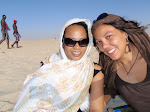
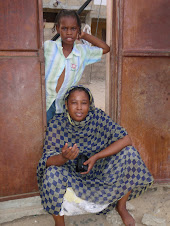
She held my hand and wouldn't let go.
I think she's seen me around and has been wanting to talk to me. She asks me the questions I can answer in Hassaniya and thinks I'm Bilani (White Moor - a way of saying I integrate well). I don't stop her. She shows me her house and lets me know i'm welcome anytime. Her mulafe is pink like her cheeks.
She held my hand and wouldn't let go.
He said he saw me and didn't know how to talk to me.
He has been in Aleg as long as I have and he struggles with Hassaniya. He does not know French, only English and his dialect from Ghana. His English is broken but he speaks in a genuine way. When I ask him about his past he says he doesn't know how to tell me. He falls silent with saddness in his eyes. His robe is white as a cloud.
He said he saw me and didn't know how to talk to me.
She wondered when I'd finally find her.
She is large and lays lazily in her botique. She gives me peanuts to eat and tells me I look Mauritanian. She asks me about my father. The mat on the floor is plastic and she gives me a pillow to lounge. She calls me an old friend. Her smile is as big as I remember. She tells me not to lose her again. Her hair is freshly braided.
She wondered when I'd finally find her.
Friday, December 12, 2008
Wednesday, December 3, 2008
The Intelligence Test
A fellow volunteer and I went to the local Jardin D'Enfants to check out a Mauritanian Preschool one sunny day. We wandered through the streets and followed directions and pointed fingers along the roads until we came upon a small, rather governmental looking compound. Upon entering our eyes fell upon what looked to be abandoned playground equipment. There was a swing-set with no swings, a unidentifiable metal frame, a rusty slide and a short metal jungle gym set up on the dirt and gravel ground. There were obvious attempts at making the swing-set an actual play thing. A black cord was strung to the top and swung down in a loop as a makeshift swing (tied and tied again from what looked to be many breakdowns). Our snooping was interrupted by the groundskeeper who welcomed us with a shy smile and offered us a seat on the steps as he prepared for the day. He mechanically laid out a mat on the dirt and began sweeping out the interior of the school.
We watched the metal door to the compound as children trickled in. The first were two young wide eyes boys brought by their teenage brother. They wandered in and stopped as they saw us, wondering what kind of people would interrupt their habitual morning. the groundskeeper herded them onto the mat where they sat quietly staring at nothing in particular. It continued as such, small children with curious faces taking seats on the mat outside. The teachers began to arrive, dressed in fantastic Pulaar clothes with grand head-wraps and bright smiles. They sat next to us on the steps and chatted as the kids continued to come in and take a place on the mat. There was one small girl who began to cry as her mom set her down, a typical response for a 2 year old. She ran to the door and her mother, one step ahead of the game, slipped sneakily out and closed it behind her. The teachers giggled at the ways of children and one woman went to sit with the traumatized toddler on the mat. One small girl, perhaps 4 years old, wandered in by herself, carrying a back-pack and a small bottle of water.
The director arrived with a flow of energy, her mulafe flowing behind her and business in her eyes. She greeted us and began to show us around. We stepped into the lobby and were greeted by the wonderful scent of stale urine. There were three rooms off the lobby, divided by 2-3, 3-4 and 4-5 year olds. The rooms were typical preschool, yet a bit more depressing. The only floor with a "carpet" was the youngest room, all others were small white rooms filled with small plastic kid-stained picnic tables. The walls were decorated with scribbles drawings and torn artwork from postcards and books. There were no toy shelves or counters filled with paper and crayons, only a chalkboard in the corner a drawing of a toothbrush and toothpaste. After a whirlwind tour she brought us to her office, just as a repetition song began, voices blending sweetly the way only children can achieve.
Once in her office she showed us cardboard boxes filled with a mess of wooden and plastic toys. With blocks, beads, and plastic pieces the torn box looked like the miscellaneous drawer everyone seems to have in a forgotten corner. She sat us at her desk and pulled out a large piece of cardboard with the edges cut out.
"An intelligence test," she said, motioning toward the wrinkled pieces "try it."
So we put the paper puzzle together (which, i might add, had us worried for a second). When she came back in she was delighted to see we were smarter than the average preschooler and quickly mumbled something about "velos". We were rushed into another room and slowly took in the mess of tricycle pieces on the floor.
"Can you put these together?" She asked.
Glancing at each other and checking the time, we agreed to take a look. We ended up back on the mat outside where the children sat in the morning with the tricycle parts to about 5 bikes lay scattered before us. The paper directions were torn and wrong, and we began to notice certain important parts were not present in the mess before us. The director came back out and handed us the tool she thought we would need.... a green and red plastic child's play hammer. I began to giggle at our situation. Sitting there with a tricycle puzzle in front of us, a bit harder than the cardboard pieces, and equip with a plastic preschool hammer. A little boy wandered out of the building and gazed at us for a while, wondering why were were having such problems when we had the best tool in the school.
After getting some of the bikes partially assembled we notified the director that while the hammer had helped a lot (we actually used it) that we had tools that would work better at our house and would return tomorrow to finish our work. We left the preschool as the children continued their rote learning repetition games. I could only wonder if we had really passed the intelligence test she had laid out before us, or if we would be forever failed in her mind - only achieving the initial cardboard stage of her tests.
We watched the metal door to the compound as children trickled in. The first were two young wide eyes boys brought by their teenage brother. They wandered in and stopped as they saw us, wondering what kind of people would interrupt their habitual morning. the groundskeeper herded them onto the mat where they sat quietly staring at nothing in particular. It continued as such, small children with curious faces taking seats on the mat outside. The teachers began to arrive, dressed in fantastic Pulaar clothes with grand head-wraps and bright smiles. They sat next to us on the steps and chatted as the kids continued to come in and take a place on the mat. There was one small girl who began to cry as her mom set her down, a typical response for a 2 year old. She ran to the door and her mother, one step ahead of the game, slipped sneakily out and closed it behind her. The teachers giggled at the ways of children and one woman went to sit with the traumatized toddler on the mat. One small girl, perhaps 4 years old, wandered in by herself, carrying a back-pack and a small bottle of water.
The director arrived with a flow of energy, her mulafe flowing behind her and business in her eyes. She greeted us and began to show us around. We stepped into the lobby and were greeted by the wonderful scent of stale urine. There were three rooms off the lobby, divided by 2-3, 3-4 and 4-5 year olds. The rooms were typical preschool, yet a bit more depressing. The only floor with a "carpet" was the youngest room, all others were small white rooms filled with small plastic kid-stained picnic tables. The walls were decorated with scribbles drawings and torn artwork from postcards and books. There were no toy shelves or counters filled with paper and crayons, only a chalkboard in the corner a drawing of a toothbrush and toothpaste. After a whirlwind tour she brought us to her office, just as a repetition song began, voices blending sweetly the way only children can achieve.
Once in her office she showed us cardboard boxes filled with a mess of wooden and plastic toys. With blocks, beads, and plastic pieces the torn box looked like the miscellaneous drawer everyone seems to have in a forgotten corner. She sat us at her desk and pulled out a large piece of cardboard with the edges cut out.
"An intelligence test," she said, motioning toward the wrinkled pieces "try it."
So we put the paper puzzle together (which, i might add, had us worried for a second). When she came back in she was delighted to see we were smarter than the average preschooler and quickly mumbled something about "velos". We were rushed into another room and slowly took in the mess of tricycle pieces on the floor.
"Can you put these together?" She asked.
Glancing at each other and checking the time, we agreed to take a look. We ended up back on the mat outside where the children sat in the morning with the tricycle parts to about 5 bikes lay scattered before us. The paper directions were torn and wrong, and we began to notice certain important parts were not present in the mess before us. The director came back out and handed us the tool she thought we would need.... a green and red plastic child's play hammer. I began to giggle at our situation. Sitting there with a tricycle puzzle in front of us, a bit harder than the cardboard pieces, and equip with a plastic preschool hammer. A little boy wandered out of the building and gazed at us for a while, wondering why were were having such problems when we had the best tool in the school.
After getting some of the bikes partially assembled we notified the director that while the hammer had helped a lot (we actually used it) that we had tools that would work better at our house and would return tomorrow to finish our work. We left the preschool as the children continued their rote learning repetition games. I could only wonder if we had really passed the intelligence test she had laid out before us, or if we would be forever failed in her mind - only achieving the initial cardboard stage of her tests.
Wednesday, November 26, 2008
A new view, an open eye
I hear the metal door to my compound pull open and I lift my head to the sound of rusty metal scrapping. I am sitting on the floor with papers and grammar books spread around me lesson planning for the following week. This group of lessons I’m trying to figure out the best way to tell my students about irregular present participles, a topic I know will be greeted with blank stares and squinted brows. Pausing, I gaze out the door of my house waiting to see who appears in the frame. I hear her before I see her.
“Ash-e-lee?” She calls, with excitement laced through her tone.
“Fatou! Je suis la – I’m right here.” I tell my friend.
She steps into my view with a huge smile plastered on her face. Opening her arms wide she shouts, “FELICITACIONS! Barack Obama – President
I laugh and stand up, immediately folded into her waiting arms while each cheek is excitedly kissed. She tells me she has been watching the news all night and that she was so happy for me – and so relieved that Americans “have chosen the right one”. I tell her about my lucky friends who were in
The day after elections electricity pulsed through my veins. I stayed up the night before listening to the radio as the polls rolled in, gazing at the brilliant stars above me and willing the American people to show the world that they can change. I received calls throughout the night, from the U.S.A., from Belize and from Mauritania, all family and friends’ assuring me that the charged pulse I felt was not only pumping in my body. That morning as the cool night turned itself over to the African sun I sat with another volunteer listening to that
Though, as in the
Living in a country that is still trying to figure out Democracy, it is a good feeling to see the message Americans are sending out to the world. An example that Democracy can work, that people should have a voice, and that there are places where those voices are heard. At times it’s unreal to see that new respect and that lingering smile in the eyes of those who watch their own country struggle.
Monday, October 13, 2008
Dreams of Different Colors
The culture in front of me is bold. It is bright. It is sacred. A father teaches his children how to pray, quietly whispering time-old secrets into their ears. A mother sifts couscous, tossing the grains into air and letting it fall into the waiting bowl. A sister shifts her baby brother on her back, old enough to stand tall, young enough to not feel the burden. A brother laughs without reserve, head tossed to the sky, as his friend chases a goat through the dusty streets. Here, a person must wait to uncover the mysteries of this sandy world, it will not happen immediately. I would never have known the secrets of fabric if I had not sat and watched, wide-eyed, as they danced in front of me. The light shone golden into the room through barred windows and outdoor children pressed their faces against the rusty metal to get a glimpse – smiles and eyes illuminated. Women step surely, carried by the Arabic strings and drums, swirling multicolored mulafes. They fix their faces into a rather proud poses, arms waving with attention to the fingers. Occasionally they cover their face with cloth, more often, they expertly shake their butts, ticking and swishing in time with the scratchy cassette tape. The men are like birds, and with their grand bou-bou’s spread like wings they fly around the room with ease. They flutter around the women, showing off the solid steps and hopping lightly with the beat. They swirl and mix, tangle and part. Laughter bubbles as they show off their moves and minutes fold into themselves.
Sometimes it seems like the sun shines too bright, or too much sand blown into your eyes to actually see. But, I suppose that is why we have five senses. I will always hear prayer call echoing through the labyrinth streets and smell lunchtime as rice and fish simmer over fire. I will feel the touch of a greeting hand and taste the bitter sugary tea from a sticky glass. I’m learning to quit making over-assumptions, and to let things go quickly. I’m learning to take it slow and to enjoy the quiet. I’m learning to laugh in a different language.
School began this week, but once again, culture morphs something so familiar to me into the unidentifiable. On the first day of classes I wondered, as I gaze at the empty school yard before me, occupied by wandering donkeys, if I’ll ever understand completely. I find the school director, Ahmed, in his quiet office. Wise and quite official looking he is dressed in a bou-bou surrounded by papers on his desk. He smiles and tells me that maybe tomorrow he’ll have the schedule ready. And – he adds – you don’t have to come by tomorrow if you’re tired. The back to school vibe is still there, I can see it when I visit the market. Children pour over carts of notebooks, choosing their colors importantly. They walk down the streets with blue UNICEF issued backpacks, the glow of newness alive in their struts. I suppose a week from now I’ll be in the swing of things. Classes will begin and students will trickle in, switching from lazy summer days to pencils, pens and notebook paper.
I have decided to move in with a Mauritanian to try and catch some things I might be missing. She is a bright spunky woman who has a three year contact with an international organization in Aleg. One year into her contract, she will finish her time in Aleg right when I will. Her name is Fatou and her family lives in Nouakchott, with her adorable son. She lives alone in a house, very similar to the one I live in currently, except that it is two minutes away from the school. She has created family here and they have welcomed me into their lives with ease. We speak in French mostly, though she knows Hassaniya (and Wolof… and Pulaar!) and helps me figure things out. I sat in a boutique late one night with her as she visited her friends. They behaved like sassy schoolgirls and we joked and sipped tea and let the night seep into our bones.
My dreams have a new shade to them. They have taken on a new tone. I see broken toothed smiles and wrinkled expressive hands. I see swirling fabrics and piles of onions on sheets. In my sleepy minds eye there are blue backpacks, wise men and unfinished schedules.
Sometimes it seems like the sun shines too bright, or too much sand blown into your eyes to actually see. But, I suppose that is why we have five senses. I will always hear prayer call echoing through the labyrinth streets and smell lunchtime as rice and fish simmer over fire. I will feel the touch of a greeting hand and taste the bitter sugary tea from a sticky glass. I’m learning to quit making over-assumptions, and to let things go quickly. I’m learning to take it slow and to enjoy the quiet. I’m learning to laugh in a different language.
School began this week, but once again, culture morphs something so familiar to me into the unidentifiable. On the first day of classes I wondered, as I gaze at the empty school yard before me, occupied by wandering donkeys, if I’ll ever understand completely. I find the school director, Ahmed, in his quiet office. Wise and quite official looking he is dressed in a bou-bou surrounded by papers on his desk. He smiles and tells me that maybe tomorrow he’ll have the schedule ready. And – he adds – you don’t have to come by tomorrow if you’re tired. The back to school vibe is still there, I can see it when I visit the market. Children pour over carts of notebooks, choosing their colors importantly. They walk down the streets with blue UNICEF issued backpacks, the glow of newness alive in their struts. I suppose a week from now I’ll be in the swing of things. Classes will begin and students will trickle in, switching from lazy summer days to pencils, pens and notebook paper.
I have decided to move in with a Mauritanian to try and catch some things I might be missing. She is a bright spunky woman who has a three year contact with an international organization in Aleg. One year into her contract, she will finish her time in Aleg right when I will. Her name is Fatou and her family lives in Nouakchott, with her adorable son. She lives alone in a house, very similar to the one I live in currently, except that it is two minutes away from the school. She has created family here and they have welcomed me into their lives with ease. We speak in French mostly, though she knows Hassaniya (and Wolof… and Pulaar!) and helps me figure things out. I sat in a boutique late one night with her as she visited her friends. They behaved like sassy schoolgirls and we joked and sipped tea and let the night seep into our bones.
My dreams have a new shade to them. They have taken on a new tone. I see broken toothed smiles and wrinkled expressive hands. I see swirling fabrics and piles of onions on sheets. In my sleepy minds eye there are blue backpacks, wise men and unfinished schedules.
Sunday, September 14, 2008
Pictures on the Walls
Stepping back, I look at the faces of my family and friends staring back at me from my walls. Now that I am in my own house in the town I will be in for the next two years, I can finally unpack all my bags and carve my place into this country. As I look a picture of my nephew Gavin stuck in a happy pose at a baseball game, cheering and holding a two-year-old fist full of hotdog toward the sky, I can feel the odd sensation spread over me once again. The realness of my situation continues to catch me off guard. The distance from the people I love and the proximity to the people in my neighborhood with whom I’ll form relationships. Not to mention the tragedy of that hotdog, something I won’t taste for a very long time... But unidentifiable ground meat becomes somewhat miniscule in comparison to the things I’m gaining here. Aleg, my town, seems to have a lot to offer me, and hopefully I’ll figure out what I can give in return.
My house is across the street from a Mosque and two doors down from my landlord’s boutique. I live in a small walled compound with a couple rooms, a small kitchen and a salon. The doors and windows, covered in bright blue cracked wood, obey the weather expanding and shrinking with Mother Nature’s commands. My bathroom and “shower” (place to stand in while I bucket-bath) are outside and laundry lines are strung about the yard. For now, there are small green patches on the ground, where sporadic grass and the infamous Death Star plants grow. Death Star is not, in fact, the real name of this macabre plant, only a name we have so lovingly assigned. Starting out rather beautiful, the Death Star dries up in the desert sun, creating tiny and very prickly balls of death, which stick into skin like an orb of splinters. Though the Death Stars are a negative, I am lucky to have electricity in part of the house, which works a good percentage of the time, and running water, accessed by a pump outside. My roof is tin and my walls are concrete and my kitchen counter was built with bricks and wood planks. My stove is a portable gas camp-style with one burner and is mostly used outdoors. It has already been used to create some rather delicious creations (Pad-Thai is very do-able here).
Every day the Mosque is my alarm clock, the sunrise call to prayer my morning wake up call. It is Ramadan this month, so the days are slow. Fasting (no food or drink – water included) is required between sunrise and sunset and the hottest and most unproductive time is between 1-3pm. Walking around at this time brings you face to face with a ghost-town. Store owners and produce vendors sleep in the shade, slowly rising if you ask for something. Eating and drinking in view of other Mauritanians seems rude and awkward, though it is sometimes forced upon you when you sit to talk with a fatigued family, as they understand many foreigners do not participate in their religious holidays. The children and oldest of old do not usually partake in the fasting, and those that do will not utter a word of complaint more than “it’s hot out today” or “I’m a little bit tired”. The dedication is empowering to see, especially given the climate. What must get them through is the wonderful event of breaking the fast at sundown. Women start preparing in the early afternoon, cutting and chopping slowly, getting things ready to drop in a pot and quickly prepare. When the Mosque announces the breaking of fast, the chanted song is only on the second syllable when cups are brought to parched mouths. What follows is amazing. I broke fast with a family one night and was in disbelief at the never ending bowls and plates set before me. There were dishes of beignets, dates, juice, water, milk, and a sweet cous-cous/water/milk/sugar mix brought out to start. A dish of meat and potatoes with bread to dip followed by a round of tea, and then even more drinks set before you. Finally there was a large dish of pasta and meat set out on a plate, followed by more rounds of tea. This celebration takes time, and I even made the mistake of trying to leave before it was over – thinking there couldn’t possibly be another course…. That night I would lay under my mosquito net in a food coma, staring up at the stars, happily stuffed and planning out another visit to break fast.
Walking through my town can take forever. I greet everyone in the Mauritanian way, which is to spit out as many inquiries as fast as possible. Included are things such as “How are you with the heat?” and “How are you with your health?” I am discovering my favorite people to sit and take tea with, and faces and names are easier with each passing day. I once walked back from the market with an empty trunk for my room, balancing it on my head with a hand, when I heard an excited greeting. I recognized that it was the mother of the family I broke fast with the night before. She beckoned me over and we went through the greetings – followed by the common “whatareyoudoing –whereareyougoing-wherewereyou.” I slapped hands and touched my heart doing my best to keep up with her Hassaniya/French. I told her I had to bring the trunk home, and she smiled and pressed a bag of beignets into my hand. When I asked her how much she waved my money away like an annoying fly, telling me it was a gift.
I know that not everyone I meet here will be as nice as her. Not everyone is willing to put up with my broken Hassaniya and cultural slip-ups. I have embarrassed myself many times already, and I know it’s only the beginning. Laughing is a good way to deal, because really, some of the situations I find myself in are simply ridiculous. Another is to always remember those pictures on the wall are always there, reminding me not of what I left behind, but of the people who continuously offer me support.
Subscribe to:
Posts (Atom)